






Commercial Room Diffusers: Olfactory Strategy for Your Brand
In the increasingly competitive retail and services landscape, brands are constantly looking for innovative tools to create memorable and engaging experiences for their customers. Among the emerging techniques that are revolutionizing the way brands communicate their value, olfactory marketing stands out, a sensory strategy that uses fragrances to influence perceptions, evoke emotions, and strengthen brand identity.
The use of room diffusers in commercial environments fits perfectly into this context, transforming physical spaces into true multisensory experiences. It's not just about "perfuming the environment," but about building an olfactory identity consistent with the brand's values, messages, and audience.
Research in neuropsychology confirms that smell is the sense most directly connected to memory and emotions. A well-chosen scent can induce positive moods, increase time spent in a store, improve the perceived quality of products and services, and even encourage purchases. This is why more and more companies – from fashion to catering, from hotels to beauty salons – are investing in professional room diffusers as an integral part of their marketing strategy.
This selection needs to be tested and customized, perhaps with the help of an olfactory marketing expert. It is also important to evaluate the intensity of the fragrance, to avoid excesses that could be unpleasant, and seasonal consistency, choosing fresher scents in summer and more enveloping ones in winter.
The important thing is not to overload the environment, distributing the diffusion points harmoniously based on customer flow and space size.
The strategic role of room diffusers in sensory branding
In sensory branding, every detail contributes to building brand perception. Visual appearance, sound, temperature, and of course, scent: everything communicates, even at an unconscious level. Professional room diffusers allow a specific fragrance to be diffused constantly and controllably, inextricably linking it to the brand's identity. For example, a wellness center might opt for relaxing notes like lavender or eucalyptus, while an urban fashion concept store might prefer dynamic citrus essences, in line with a youthful and innovative spirit. In any case, the choice of fragrance is not random: it is studied based on the target audience, brand positioning, and communication objectives. Oniusa Venezia offers tailor-made solutions for every commercial need, proposing technologically advanced room diffusers and a wide range of essences created by Italian master perfumers. Diffusion can be customized for intensity, frequency, and location, ensuring a constant but never intrusive effect.Fragrances and consumer behavior: a scientifically proven link
Numerous studies demonstrate the effectiveness of using scents in commercial environments. Fragrances can:- Increase dwell time in an environment: a pleasant smell encourages people to stay longer, increasing the likelihood of purchase.
- Enhance brand recall: people more easily remember a brand associated with a positive sensory experience.
- Stimulate impulse buying: certain olfactory notes, such as sweet or citrus scents, can activate emotions that lead to unplanned purchases.
- Strengthen customer loyalty: customers are more likely to return to places where they felt welcomed and pampered, partly due to the olfactory atmosphere.
1. What is Olfactory Marketing?
Olfactory marketing is a branch of sensory marketing that uses fragrances as a strategic tool to communicate a brand's identity, enhance customer experience, and influence purchasing behavior. Unlike visual or auditory advertising, scent acts at a deeper, unconscious level: it directly stimulates the limbic system, the part of the brain responsible for emotions and memories. In practice, it involves creating a personalized "olfactory signature" that represents the brand and is diffused in sales points, showrooms, waiting rooms, or workplaces through specific room diffusers. This signature becomes an integral part of the experience the customer has with the brand, generating a positive and lasting association.Concrete examples of olfactory marketing
- Luxury hotels: hotel chains like Marriott or Westin use exclusive fragrances in their lobbies to convey a sense of elegance, cleanliness, and welcome. Guests immediately recognize that scent and associate it with a positive and refined experience.
- Retail and fashion: brands like Abercrombie & Fitch or Zara Home diffuse scents consistent with their visual and stylistic identity, helping to create a coherent and immersive atmosphere that stimulates the senses and builds customer loyalty.
- Automotive: some dealerships diffuse essences like leather, wood, or fresh notes to evoke the quality and newness sensation of a freshly purchased car.
Benefits of using room diffusers in stores
The adoption of room diffusers in commercial spaces offers numerous strategic advantages. These devices not only help to improve air quality but also become true allies in building brand identity and creating an environment conducive to business.Brand Recognition
A well-designed fragrance consistent with corporate values becomes an olfactory signature that strengthens the emotional bond between customer and brand. This distinctive scent is stored at an unconscious level and recognized even after some time, making the brand more easily identifiable and memorable. Consider how, upon entering certain stores, you immediately recognize the brand even before seeing its logo: this is the power of olfactory marketing. Room diffusers, thanks to their technology, ensure continuous and uniform diffusion of the scent, keeping the brand's identity strong and consistent.Improved customer experience
Studies show that the right scent can significantly improve customers' mood, reduce stress, and make them feel more relaxed and welcomed. A scented environment helps create a pleasant and inviting atmosphere, making the shopping or waiting experience more positive and memorable. Customers tend to spend more time in pleasantly scented environments, and this increases opportunities for interaction with the products or services offered. Furthermore, the targeted use of certain fragrances can also stimulate specific sensations: citrus notes for energy, floral notes for relaxation, spicy notes to convey exclusivity.Increased sales
An important advantage of using room diffusers is their direct impact on sales. Various scientific studies, including research published in marketing and behavioral psychology journals, show a correlation between scented environments and a sales increase of up to 20%. In particular, a study by the University of Washington showed that consumers exposed to a simple fragrance consistent with the environment tended to buy more and evaluate products more positively. Another study conducted in the Netherlands revealed that in the presence of a pleasant scent, people were more likely to make impulse purchases. Therefore, room diffusers are not just tools to improve the aesthetics of a space, but true marketing levers capable of influencing consumer behavior in a concrete and measurable way.Selecting the right fragrance for your brand
Choosing the perfect fragrance for your brand is not a casual process, but a strategic decision that requires awareness, creativity, and consistency with the company's identity. Each scent has the ability to evoke specific sensations, memories, and emotions; therefore, it is essential to select an essence that reflects not only the style of the retail space but also the brand's values, target audience, and message. A brand positioned as natural and sustainable, for example, might opt for green, herbaceous, or woody notes, while a luxury brand might lean towards more sophisticated essences like oud, amber, or spicy vanilla. The fragrance thus becomes part of the brand's communicative language, conveying a silent but powerful message to the customer.How fragrances influence emotions and behaviors
Here are some general guidelines for understanding the link between fragrances and emotions:| Fragrance Type | Emotional Effect | Suitable for |
| Citrus (lemon, orange) | Energetic, stimulating | Youthful, sports, dynamic stores |
| Floral (lavender, jasmine) | Relaxing, welcoming | Beauty centers, spas, boutiques |
| Spicy (cinnamon, ginger) | Warm, sophisticated | Hotels, luxury showrooms, furniture stores |
| Marine/fresh | Clean, modern | Medical offices, tech stores, minimalist environments |
| Woody (cedar, sandalwood) | Solid, reassuring | Eco-friendly brands, co-working spaces, libraries |
Types of room diffusers for commercial spaces
There are different types of room diffusers, each with specific characteristics and advantages depending on the size of the space, the type of environment, and the brand's objectives. Let's look in detail at the main options used in commercial environments:Nebulizing diffusers
Nebulizing diffusers represent the most professional and technologically advanced solution. They work by transforming the liquid fragrance into micro-particles, diffusing them uniformly into the environment without the use of heat or water. This system is ideal for:- Large commercial spaces such as showrooms, galleries, hotels, shopping centers.
- Environments that require a constant and persistent scent, adjustable in intensity and frequency.
- Automated and timed applications for complete diffusion control.
Reed diffusers
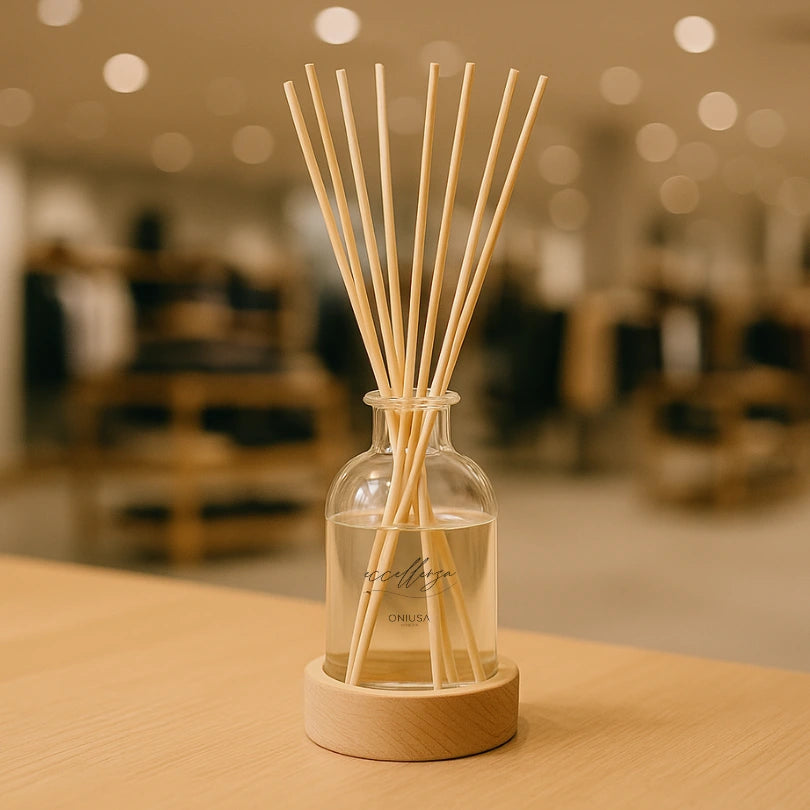
Reed diffusers, also known as capillary diffusers, are a more decorative and localized choice. They work by absorption: fiber or wood reeds soak up the scented liquid and slowly release it into the air. This type is perfect for:- Smaller areas such as changing rooms, reception areas, bathrooms, relaxation areas. Creating scented micro-environments within a larger space.
- Brands that desire an artisanal, natural, or minimalist approach.
Integrated HVAC systems
For those who desire an invisible and fully integrated solution, HVAC systems represent the top of the range. These devices connect directly to the building's ventilation systems, allowing the fragrance to be diffused through the air ducts. These systems are recommended for:- Very large structures such as hotels, corporate offices, convention centers.
- Environments where it is necessary to uniform the scent across multiple floors or areas.
- Brands with high customization and discretion needs.
Implementing an effective olfactory strategy
A well-planned olfactory strategy can transform a simple commercial space into a multisensory experience capable of engaging, building loyalty, and stimulating purchases. However, to be truly effective, the introduction of room diffusers must follow a series of key steps that go beyond the simple choice of fragrance. It is a structured process that combines target analysis, technical choices, and operational continuity.Customer target analysis
The first step to building a winning olfactory strategy is to thoroughly understand your target audience. Olfactory preferences can vary enormously based on factors such as age, gender, culture, and even the season. Understanding these aspects is fundamental to choosing a fragrance that resonates with your target and evokes positive emotions.- A younger audience might appreciate sparkling, fresh, or fruity essences.
- More mature customers may be drawn to sophisticated, woody, or spicy notes.
- In environments frequented by families, relaxing and neutral fragrances, such as vanilla or talcum powder, are recommended.
Strategic placement of diffusers
Once the fragrance is chosen, it is essential to decide where to place the diffusers to achieve effective and natural diffusion. Correct placement ensures that the essence is perceived uniformly, without being intrusive or, conversely, too weak. Here are some guidelines:| Area | Objective | Recommended diffuser type |
| Entrance/Entryway | First impression, welcome | Nebulizing diffuser |
| Sales area | Immersive experience, purchase stimulus | HVAC or nebulizing diffuser |
| Changing rooms/enclosed spaces | Comfort, privacy | Reed diffuser |
| Bathrooms or relaxation areas | Freshness, cleanliness | Reed or automatic diffuser |
| Reception/waiting room | Pleasant wait, stress reduction | Nebulizing or reed diffuser |
Maintenance
Once implemented, the olfactory strategy must be maintained over time to preserve its effectiveness and consistency. Discontinuous or poorly managed scenting can compromise the customer experience, even proving counterproductive. Here are some essential tips:- Regular checks: verify the fragrance level and proper functioning of the devices.
- Periodic cleaning of diffusers: to prevent residue buildup and ensure even diffusion.
- Seasonal updates: evaluate whether to change fragrances based on the season or promotional events.
- Staff training: educate staff on the importance of the olfactory environment and how to manage it correctly.
Conclusion
In an era where customer experience is at the heart of every successful strategy, the integration of room diffusers into the sensory branding strategy represents an innovative and highly effective choice. Scent, often underestimated, is in reality a very powerful tool: it is not seen, it is not touched, but it imprints itself on memory and heart, transforming a simple store visit into a lasting memory. Olfactory marketing is not just an "extra," but a distinctive element that silently communicates brand values, strengthens the visual and emotional coherence of the environment, and above all creates an authentic emotional connection with the customer. Through the conscious and strategic use of room diffusers, every commercial space can become a welcoming, recognizable, and beloved place. If you run a business and want to differentiate yourself from competitors, improve your customers' sensory experience, and strengthen your brand identity, adopting a personalized olfactory strategy is the next step to take.F.A.Q. - Room diffusers in commercial environments
Choosing the right fragrance starts with a careful analysis of brand values, target audience, and the emotions you want to evoke in your customers. Fresh and energetic fragrances work well for dynamic and youthful brands, while warm and enveloping notes are ideal for refined or relaxing environments. It can be useful to rely on specialized consultants who help create a personalized olfactory signature.Yes, absolutely. There are customizable room diffusers that perfectly adapt to every type of business: from clothing stores to hotels, from beauty centers to showrooms, to professional offices and pharmacies. The versatility of the different systems (nebulization, reeds, HVAC) allows for effective scenting of spaces of all sizes and styles.Costs can vary based on several factors: type of diffuser chosen, size of the space to be scented, selected fragrance, and maintenance services included. However, there are solutions for every budget, from basic options with reed diffusers to professional nebulizing or HVAC systems with digital control.Of course! Many brands choose to update fragrances based on the season, holidays, or specific promotional campaigns. This allows for maintaining a consistently fresh, surprising, and engaging olfactory experience, increasing the positive effect on the customer and renewing the perception of the environment.Effectiveness can be evaluated by observing several indicators:- Customer feedback, both direct and through reviews.
- Time spent in the store, which tends to increase in pleasantly scented environments.
- Increase in sales or impulse purchases.
- Customer return frequency, also linked to the perceived level of comfort and well-being.
Share
Read more

Laundry perfumes: a sensory guide to fibers, fragrances, and personal style
The gesture that tells who you are Laundry perfumes don't just scent fabrics: they tell stories of habits, tastes, and seasons of life. They are a daily ritual, simple yet deeply evocative. And li...

Magnolia absolute: the new fragrance celebrating the arrival of spring
With the arrival of spring, nature awakens, filling the air with fresh and delicate scents that transform every environment into a place of harmony and well-being. It is in this setting that Magnol...


