







How many reeds should you put in the diffuser? The guide to a perfect fragrance
A reed diffuser is designed to spread fragrance consistently and naturally, but the final result also depends on an often-underestimated detail: the number of reeds inserted into the bottle.
This is one of the most common questions for those who want to achieve a balanced, elegant, and long-lasting room fragrance. The answer, however, is not the same for everyone.
Generally, 5 to 8 reeds are used, but the ideal quantity varies depending on the room size, desired intensity, fragrance concentration, and even the material the reeds themselves are made from.
Understanding how this balance works means transforming the room diffuser into a true sensory design element, capable of accompanying daily life with discretion, continuity, and character.
How many reeds to use in a diffuser? It depends on the environment and the desired effect.
Each reed represents a surface through which the fragrance evaporates. Increasing their number also increases the amount of scent released into the air. It's a simple, yet extremely effective principle.
In a small study or bedroom, five reeds may be enough to achieve a delicate and constant diffusion. A large living room, an open-plan space, or an entrance with high ceilings, however, might require six, seven, or eight reeds to fully enhance the chosen olfactory signature.
The season also affects the result. In warmer months, evaporation is naturally faster, while in winter, diffusion tends to be more gradual. For this reason, the number of reeds can be adjusted throughout the year without altering the fragrance's identity.
The ability to customize intensity is one of the great advantages of reed diffusers: there isn't a single rule, but a balance built around the space and the habits of those who live in it.
Do more reeds mean more fragrance? Yes, but also a different duration.
This is probably the most frequent doubt after purchasing a diffuser.
The answer is yes: inserting more reeds increases the intensity of the fragrance. At the same time, however, it accelerates the evaporation of the liquid and reduces the overall duration of the diffuser.
For this reason, it is advisable to find the right compromise between olfactory presence and product autonomy.
If you desire a discreet and continuous fragrance, you can start with five reeds and add one at a time until you reach the desired effect. If, on the other hand, you want to create a more intense perception, for example during a reception or at particular times of the year, it will be sufficient to use all the reeds provided with the diffuser.
Room fragrance should never be intrusive. The best fragrances accompany spaces naturally, leaving an elegant trail that is perceived upon entering the room without ever overpowering it.
Rattan or fiber reeds: what's the difference?
Not all reeds are created equal. The material they are made from directly affects the quality of fragrance diffusion, the consistency of evaporation, and the overall olfactory experience.
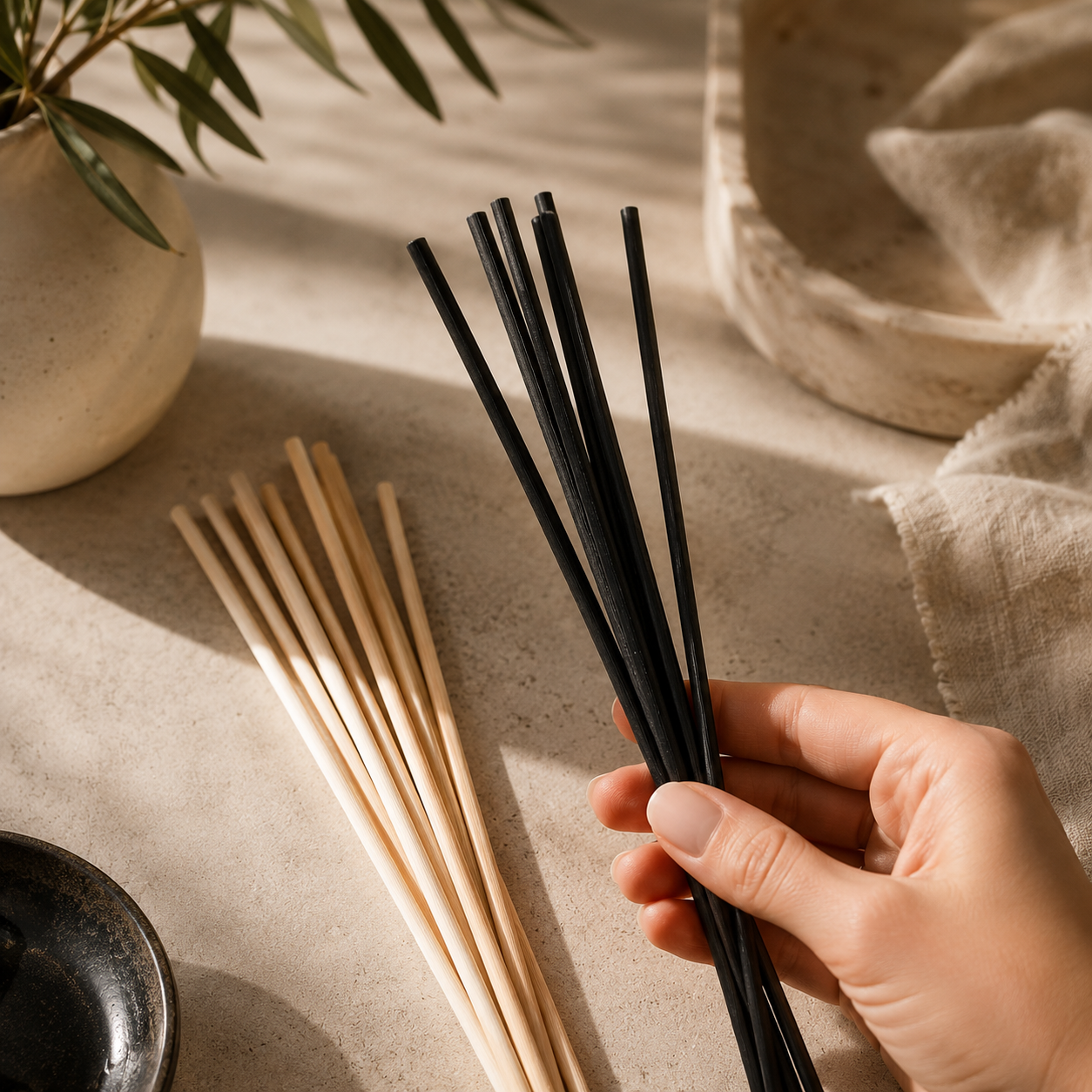
Rattan reeds, derived from a tropical palm, are a traditional choice appreciated for their natural elegance. Their structure features thin internal channels that allow the liquid to slowly rise by capillary action. Precisely because it is a natural material, each reed can have slightly different characteristics, influencing the speed at which it absorbs and releases the fragrance.
Fiber reeds, on the other hand, are designed to offer a more uniform diffusion. Their technical structure ensures regular absorption of the liquid and constant distribution of the fragrance over time. This solution allows for a more stable and predictable intensity, particularly appreciated when a continuous and perfectly calibrated olfactory signature is desired.
For this reason, many contemporary high-end diffusers use fiber reeds, capable of enhancing the olfactory composition with greater precision. Even an apparently simple detail thus becomes an integral part of the sensory project, helping to define the character of the fragrance and how it interacts with the architecture of the spaces.
How often should you flip the reeds?
Flipping the reeds is a simple but important gesture. When the part immersed in the liquid is exposed to the air, the fragrance diffusion immediately increases, providing a more intense perception.
In most cases, it is sufficient to flip them every five to seven days. If the fragrance seems less noticeable than usual, it may be helpful to do this sooner.
However, it is advisable to avoid doing it every day. Too frequent flipping significantly increases the evaporation of the liquid and reduces the overall lifespan of the diffuser.
Placement also affects performance. A diffuser placed near heat sources, open windows, or air conditioning systems will consume the fragrance more quickly than one placed in a sheltered spot in the room.
Small adjustments thus allow for maintaining balance, continuity, and quality of diffusion over time.
Oniusa Venezia: where every detail builds an olfactory signature.
In a refined environment, nothing is left to chance. Materials, light, fabrics, and scent all contribute to defining an identity that is perceived even before it is described.
This is the philosophy that guides Oniusa Venezia in creating its home fragrances. Reed diffusers are not just simple furnishing accessories, but elements capable of interacting with spaces, accompanying their rhythm with discretion and continuity.
The Couture, Eccellenza, Bòtanica, Vacanze Italiane, Il Fascino del Tempo, and Colors collections interpret different atmospheres, transforming every environment into a recognizable place through scent. The result is a measured, elegant, and consistent olfactory presence with the concept of everyday luxury.
Choosing the right number of reeds therefore means personalizing this experience, calibrating the diffusion according to the space and one's habits. Because a quality fragrance never invades the environment: it accompanies it naturally, becoming part of its emotional architecture.
Frequently asked questions
How many reeds should I put in the diffuser?
In most cases, five to eight reeds are recommended. The ideal quantity depends on the size of the room, the diffuser format, and the desired intensity.
Can I use fewer reeds?
Yes. Reducing the number of reeds makes the fragrance more delicate and can help prolong the life of the liquid.
Do more reeds make the scent stronger?
Yes. A greater number of reeds increases the evaporation surface and intensifies diffusion, but it also accelerates fragrance consumption.
Is it better to use rattan or fiber reeds?
Rattan is a natural material characterized by internal channels, while fiber has a more uniform structure. Fiber reeds tend to offer a more regular and consistent diffusion.
How often should I flip the reeds?
Generally, it is sufficient to flip them every five to seven days, or when the presence of the fragrance seems less noticeable.
When should I replace the reeds?
It is advisable to replace them when they are saturated, when they no longer properly diffuse the fragrance, or when using a different scent.
Read more
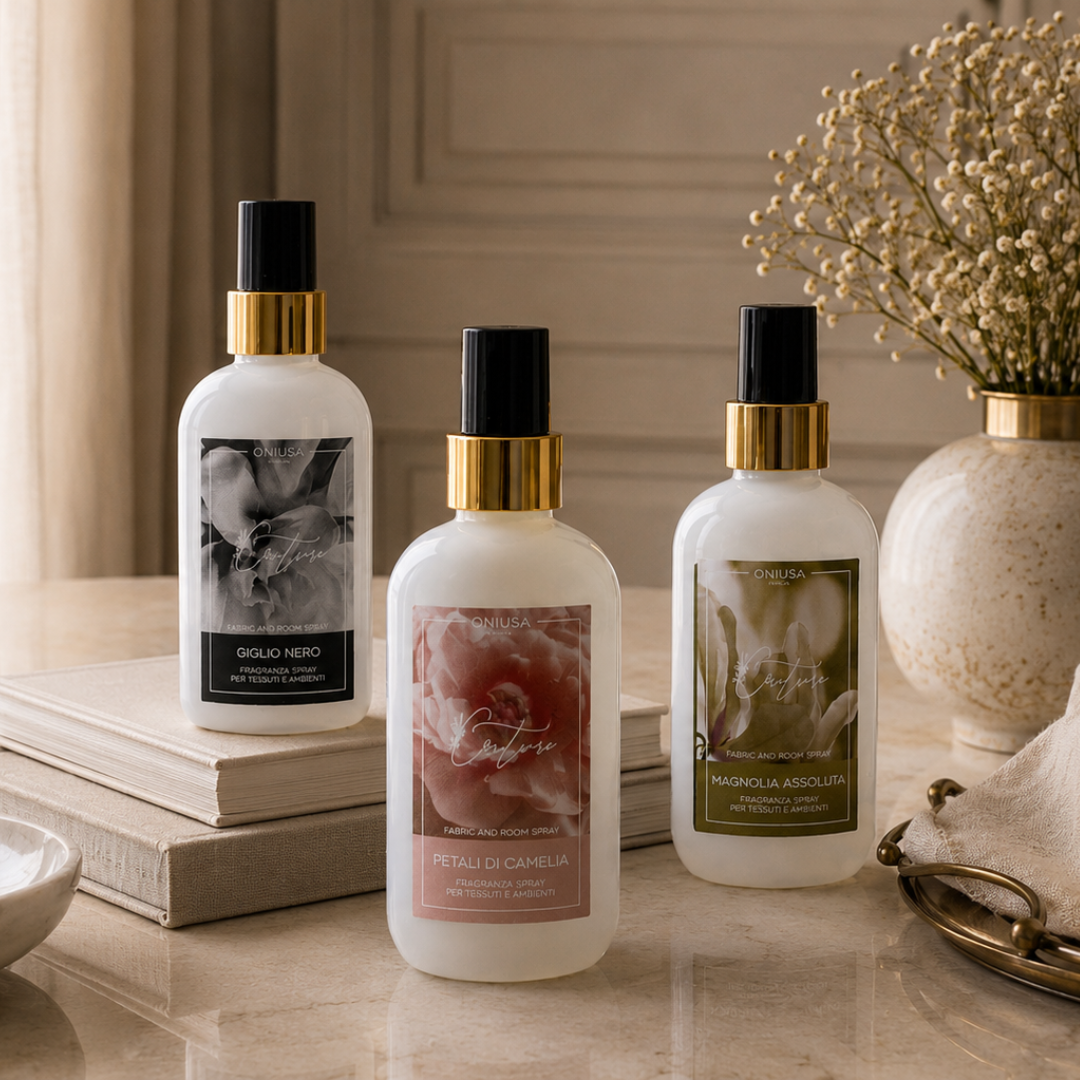
Scent is one of the most important details in creating a home's atmosphere. Oniusa Venezia's sanitizing room and textile sprays allow you to refresh rooms and textiles with a simple gesture, helpin...

The Feast of the Redeemer is much more than a Venetian tradition: it is a celebration of light, water, emotions and memory. A sensory journey that also inspires Oniusa Venezia's creations, where sc...


